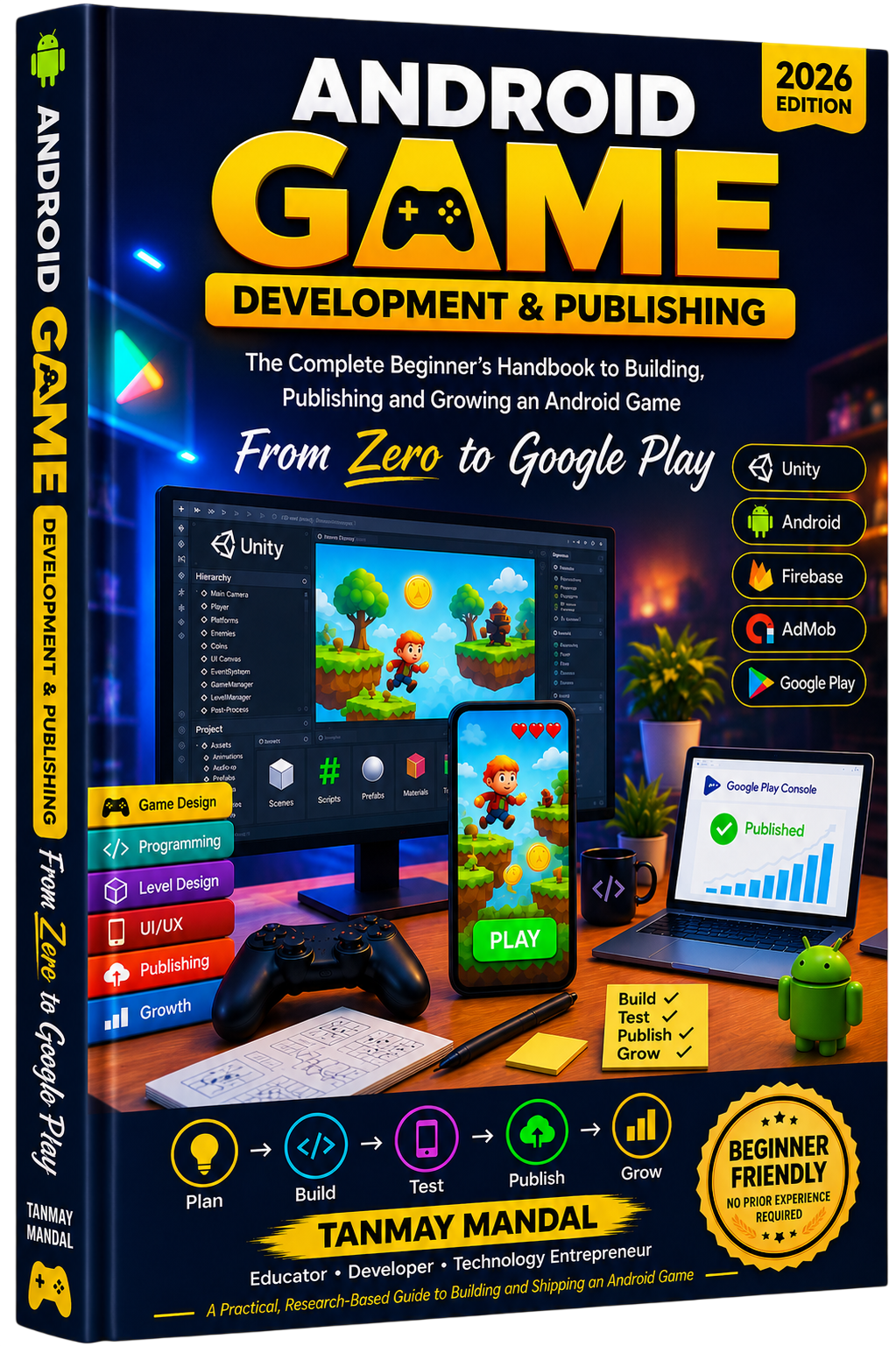
A complete, step-by-step handbook for planning, building, testing, publishing, and growing an Android game — even if you're using AI to help you code.
Stop jumping between disconnected Unity tutorials, fragmented Firebase docs, and AdMob videos. Get one structured blueprint from zero to a published, revenue-ready game.
Writing code is only 30% of launching a successful mobile game. You also need architectural discipline, Google Play compliance, QA testing, and real user acquisition.
How 90% of beginners get stuck
The engineering & publishing blueprint
Whether you have never written a line of code or you are an engineer looking to publish your first commercial Android game.
You have an exciting mobile game idea but don't know where to start, what engine to pick, or how to avoid overwhelm.
You need a lean, realistic workflow tailored for a one-person team to ship games without burning out.
You use ChatGPT, Claude, Codex, or Cursor and want a bulletproof architecture so AI generates clean, maintainable code.
You want to master Unity game architecture alongside the real-world Android build pipeline and Play Services.
You want to move from rough prototypes to a commercially polished Android game listed on the Google Play Store.
You want structured mental models, checklists, and clear technical guidance without confusing academic jargon.
111 dense, highly actionable pages divided into 5 Core Parts and 3 Execution Frameworks.
GDD creation, scope management, engine selection, Unity 6 setup, Git version control, and core loop definition.
Modular architecture, clean C# patterns, level progression, mobile UI/UX, responsive canvas, audio mix, and 60 FPS performance optimization.
Android SDK/NDK setup, Keystore generation, Firebase Analytics, Crashlytics, AdMob mediation, and Google Play Games Services integration.
Google Play Console navigation, closed testing management, tester feedback collection, privacy compliance, AAB build generation, and release review.
App Store Optimization (ASO), conversion rate tuning, player retention analytics, non-intrusive monetization strategies, and live-ops updates.
The complete worked project including finished GDD, architecture diagrams, testing checklists, and V1.1 live-ops prioritization dashboard.
A proven, phase-by-phase blueprint with exit criteria before you write the next line of code.
Define core gameplay loop, audience profile, V1.0 scope boundaries, and monetization model. Lock the Game Design Document.
Build the core mechanic in Unity. Deploy and verify the first APK on a real physical Android device to test touch controls.
Implement level systems, local persistent save states, audio triggers, UI menus, and run your first 5-player test session.
Integrate Firebase Analytics, Crashlytics, and AdMob banners/rewarded video ads without breaking the gameplay loop.
Code freeze. Run the 24-point release QA checklist, profile memory and battery usage, and create the signed Release AAB bundle.
Manage closed testing, satisfy Google Play policy requirements, prepare store listings/screenshots, and trigger staged rollout.
Learn the 7-step engineering gate system to use AI tools (ChatGPT, Claude, Cursor) as precise implementation partners.
12 worksheets, trackers, and checklists that remove guesswork and speed up your launch by weeks.
Step-by-step diagnostic trees for the most common errors in mobile game development.
Your release is rejected with a vague policy violation message.
Panic and arbitrarily change ten different manifests, SDKs, and privacy links at once.
1. Extract exact policy reference → 2. Identify affected permission/SDK → 3. Run audit prompt → 4. Implement single minimal fix → 5. Verify in internal track → 6. Submit appeal with evidence.
Get instant lifetime access to the handbook, checklists, prompt packs, and future 2026 revisions.
One-time payment · Instant digital PDF download · No recurring charges
GET THE COMPLETE E-BOOK (₹399)Everything you need to know before getting your copy.
No. The handbook starts from absolute zero. It introduces core architecture, Unity concepts, and C# principles cleanly without overwhelming you with abstract computer science theory.
Yes, absolutely. In fact, there is an entire dedicated section on the 7-step Safe AI workflow with 22+ copy-paste prompts designed specifically to prevent AI from breaking your game architecture.
Yes. The publishing section walks you step-by-step through Google Play Console requirements, organizing closed tests, managing tester feedback, and satisfying criteria for production track access.
It is a comprehensive 111-page high-resolution PDF handbook with companion worksheets and checklists designed to sit beside you on your desk as an active execution reference.
Immediately after successful checkout, you will be redirected to the secure download page and receive an email with your direct PDF download link.
The handbook uses modern Unity 6 LTS workflows while keeping core C# and mobile architectural patterns compatible across any recent Unity version (2022 LTS and newer).
Define the idea. Build the smallest playable MVP. Test thoroughly. Publish securely on Google Play.